
Choosing a joint replacement surgeon is one of the more consequential healthcare decisions many patients make.
With so many options available in Palm Beach County, it can be hard to know where to start. Credentials matter, but so does understanding what those credentials actually mean. Here’s a closer look at the factors many patients find worth considering.

Board Certification
Board certification through the American Board of Orthopedic Surgery confirms that a surgeon has completed rigorous training and met established standards in the field. It’s a baseline credential worth confirming, but it doesn’t say much about a surgeon’s specific focus—many board-certified orthopedic surgeons treat a broad range of conditions, from sports injuries to spine issues to joint replacement.
Fellowship Training in Joint Reconstruction
Fellowship training narrows the focus. After completing an orthopedic residency, some surgeons pursue an additional year of fellowship training specifically in adult hip and knee replacement, often at leading academic medical centers. This additional year typically includes:
- Concentrated exposure to complex primary and revision cases
- Hands-on training with the latest implant technology and surgical approaches
- Mentorship under experienced joint replacement surgeons
- Research and academic involvement specific to hip and knee replacement
This additional training means more concentrated experience with both robotic-assisted and traditional replacement techniques before ever treating patients independently in practice. When a surgeon’s training focuses specifically on hip and knee replacement, it often reflects deeper preparation for these procedures.
Robotic System Certification
If robotic-assisted surgery is part of the conversation, ask which system the surgeon is certified on and how they obtained that certification. Systems like Mako require dedicated training separate from general surgical training, covering both the technology itself and how it integrates into surgical planning. A surgeon’s certification history—including ongoing training as robotic systems evolve—can indicate how current their approach is.
Professional Involvement in the Field
Many surgeons stay engaged with their field well beyond their own operating room. This kind of involvement can take a few forms:
- Fellowship status in professional societies, such as the American Association of Hip and Knee Surgeons
- Peer review work for medical journals, such as The Journal of Arthroplasty
- Hospital leadership roles, such as a governing board or co-management committee position
- Ongoing continuing education and faculty instruction for other surgeons
Involvement like this often reflects ongoing engagement with the latest research and techniques and can indicate a surgeon invested in the broader quality of care at their institution, not just individual procedures.
Communication and Comfort Level
How a surgeon communicates matters too. A consultation is a good opportunity to gauge whether a surgeon takes time to answer questions, explains treatment options clearly, and makes you feel comfortable with the plan. Many patients find that the right fit involves both strong qualifications and a surgeon who takes the time to understand their specific goals, whether that’s returning to golf, keeping up with grandchildren, or simply walking without pain.
Questions Worth Asking During a Consultation
- What is your specific training in hip and knee replacement?
- What robotic systems are you certified on, and how long have you used them?
- Are you involved in professional organizations or research related to joint replacement?
- How do you approach treatment planning for a patient with my specific situation?
Making a Confident Choice
No single credential tells the whole story. Board certification, fellowship training, robotic certification, and ongoing professional involvement each add a piece to the picture. Taking the time to ask questions during a consultation can help you feel confident in whoever you choose to trust with your care.
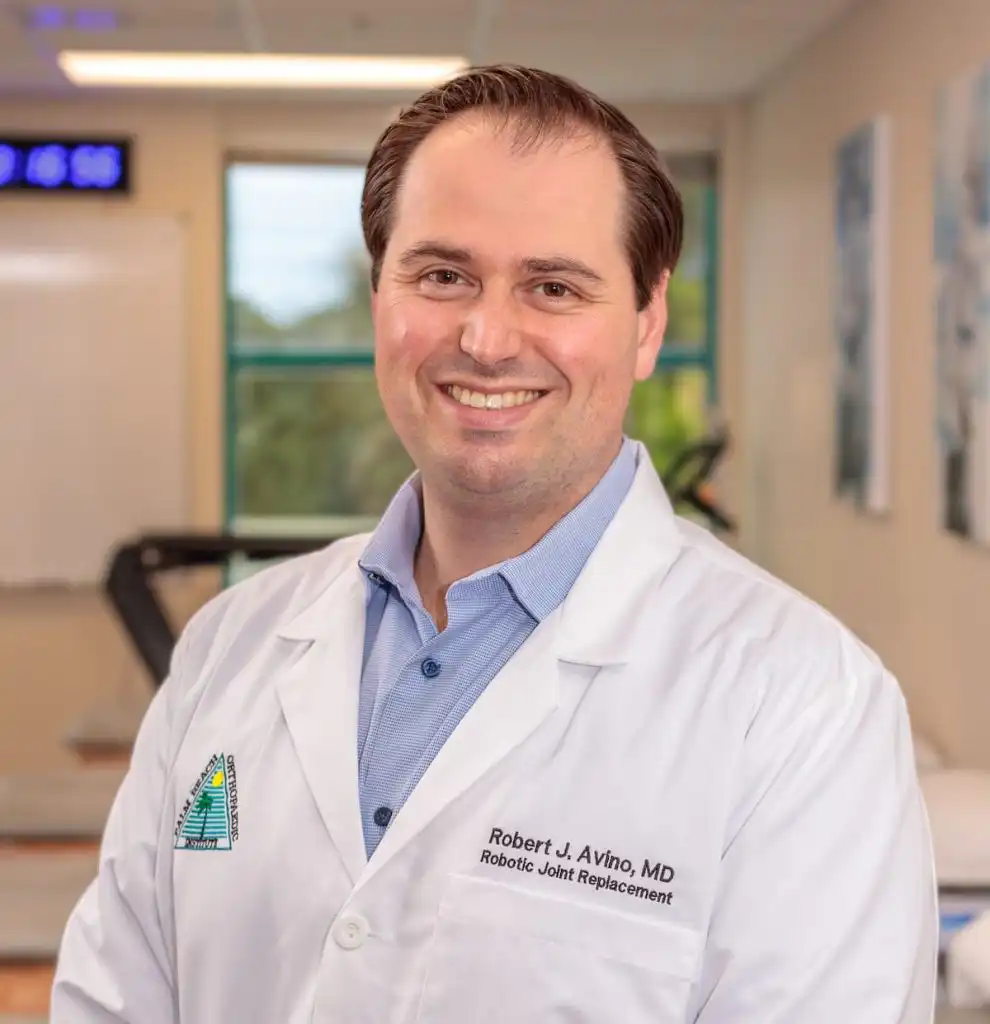
Dr. Robert J. Avino, M.D., a board-certified, fellowship-trained orthopedic surgeon in Palm Beach Gardens, welcomes these kinds of questions from every patient he sees.
Schedule a Consultation Today
If hip or knee pain is slowing you down, don’t wait. Request a consultation online or call
Palm Beach Orthopedic Institute and ask for Dr. Robert J. Avino.