
If you are planning a hip replacement in Jupiter, you will hear two terms as you compare surgeons: traditional hip replacement and robotic hip replacement.
Robert J. Avino, M.D., is a board-certified, fellowship-trained orthopedic surgeon who sees patients in Jupiter and performs hip replacement with Mako technology. He has performed 1,400+ robotic hip and knee replacements, including 1,000+ robotic hip replacements. He completed his fellowship in Adult Hip and Knee Reconstruction at Cleveland Clinic and is accredited by Surgical Review Corporation (SRC) as a Master Surgeon in Robotic Joint Replacement.

What Traditional Hip Replacement Involves
In a traditional hip replacement, the surgeon plans the procedure from X-rays and performs it with manual instruments. Implant size and position are estimated before surgery and finalized in the operating room, using anatomic landmarks, alignment guides, and the surgeon’s judgment. Some surgeons also take X-rays during the procedure to check their work. This is a well-established operation with a long record. In experienced hands, traditional technique serves many patients well.
What Robotic-Assisted Hip Replacement Involves
Robotic-assisted hip replacement begins before the day of surgery. With Mako technology, a CT scan is used to build a 3D model of the patient’s hip. The surgeon uses that model to plan implant size and position, along with leg length and hip offset (a measurement that affects how the muscles around the hip are tensioned).
In the operating room, the robotic arm helps the surgeon prepare the socket and place the cup component according to that plan. The arm does not move on its own. The surgeon guides it, and the system keeps the work within the planned boundaries. During the procedure, the system reports measured values against the plan so the surgeon can confirm them before finishing.
How the Two Compare
The differences fall into three areas.
- Planning. Traditional planning is based on two-dimensional X-rays. Robotic-assisted planning is based on a 3D model of the individual hip, built from a CT scan, with the plan set before surgery.
- Execution. Traditional technique relies on manual instruments, landmarks, and the surgeon’s eye. With robotic assistance, the surgeon uses a robotic arm to hold the socket preparation and cup placement at the planned position.
- Verification. In traditional surgery, the surgeon assesses implant position, leg length, and offset, sometimes using intraoperative X-rays. With robotic assistance, the system measures and reports them during the procedure.
Some things do not change. The types of implants are similar, the surgery still depends on the surgeon’s skill and judgment, and recovery still depends on the patient’s health and commitment to rehabilitation.
What the Research Shows, and What It Does Not
Published studies have generally reported that robotic-arm assistance places the socket component within the surgeon’s target range more consistently than manual technique. Component position is one of several factors associated with hip stability and implant wear over time.
Research on whether that consistency translates into differences in long-term results is still developing, and individual results vary. Robotic assistance does not remove the risks of surgery, and it is not a substitute for experience. Any surgeon you consult should be willing to discuss both points plainly.
The Surgical Approach Matters Too
Technology is one decision. The surgical approach, meaning how the surgeon reaches the hip joint, is another. Dr. Avino performs 100% of his current primary total hip replacements through the direct anterior approach, which reaches the hip from the front of the body and works between muscles instead of detaching them. For appropriate candidates, it may support an earlier return to walking and daily activity.
He pairs that approach with Mako technology. The robotic-assisted hip replacement page describes how the two work together and what recovery may involve.
Why the Surgeon Matters More Than the System
A robotic system is a tool, and results depend on the surgeon using it. When comparing surgeons in Jupiter and across Palm Beach County, ask how many robotic-assisted hip replacements each has performed and how many they perform each year.
Dr. Avino has performed 1,000+ robotic hip replacements and performs 250+ primary total hip replacements annually. He also serves as a faculty instructor for Stryker courses that train other surgeons in Mako total hip replacement and direct anterior techniques.
His SRC accreditation is an independent review of that experience. SRC’s standards for the Master Surgeon in Robotic Joint Replacement designation include at least 150 robotic joint replacements per year, along with requirements for team training, clinical pathways, and outcomes tracking. The SRC accreditation announcement covers the details.
Which Is Right for You?
That is a conversation to have at a consultation. Dr. Avino reviews your imaging, your activity goals, and your overall health, then explains whether hip replacement is appropriate and what the plan would involve. Many patients with advanced hip arthritis are candidates for a robotic-assisted procedure, depending on the patient.
To learn more about Dr. Avino’s training and practice, visit the homepage for hip and knee replacement in Palm Beach County.
Consider Contacting Us Today
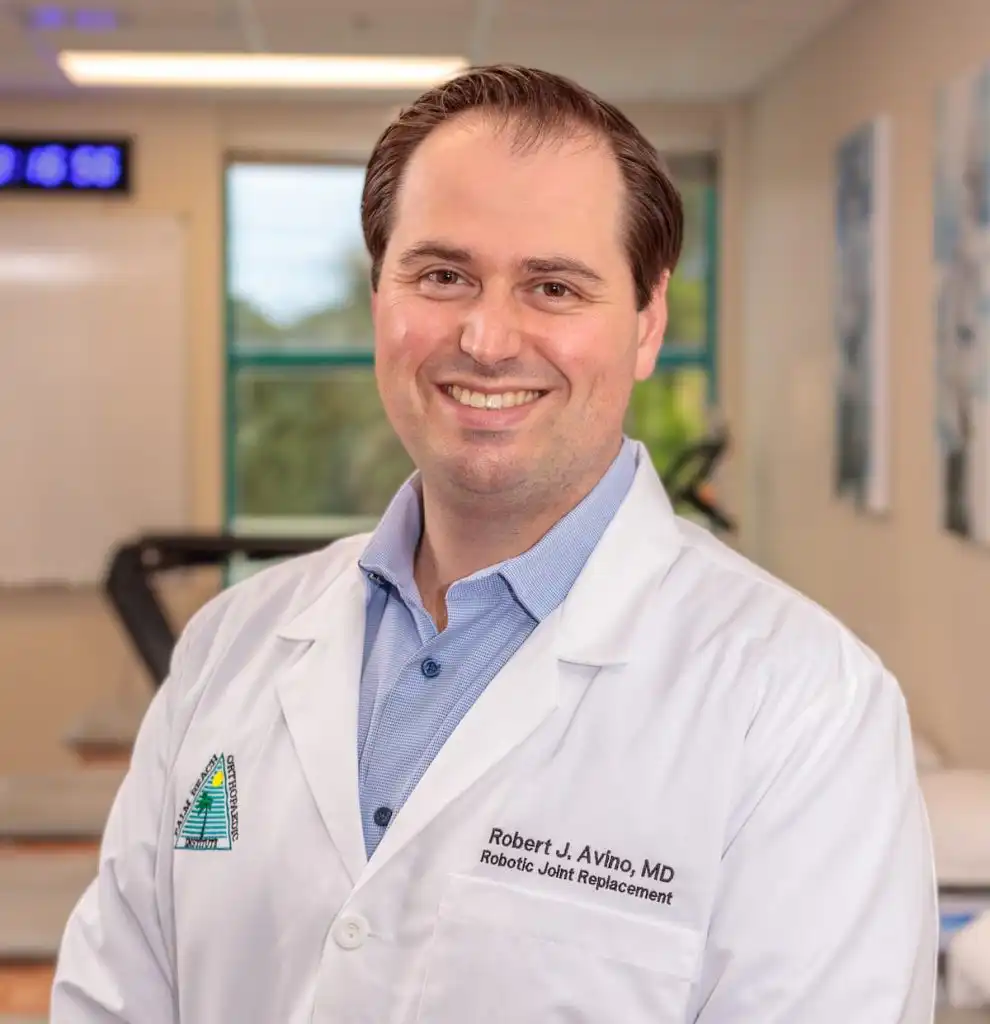
If you are exploring robotic hip or knee replacement in Palm Beach County, Robert J. Avino, M.D., is here to help. Dr. Avino is a board-certified, fellowship-trained orthopedic surgeon who focuses on robotic-assisted hip and knee replacement at Palm Beach Orthopedic Institute in Palm Beach Gardens.
To request a consultation, complete our online contact form, and a team member will follow up with you. You can also call (561) 694-7776 and ask for Dr. Avino.
Frequently Asked Questions
No. Dr. Avino performs the surgery. The robotic arm is a tool that helps him carry out a plan built from a CT scan of your hip, and he guides it throughout the procedure.
Yes. Mako planning is based on a CT scan taken before surgery. The scan is used to build a 3D model of your hip, which the surgical plan is based on.
Not necessarily. Candidacy depends on the condition of the hip, overall health, and other individual factors. Dr. Avino determines this at a consultation.
Recovery depends on several factors, including the surgical approach, overall health, and commitment to physical therapy. For appropriate candidates, same-day discharge may be an option. Dr. Avino discusses what to expect based on your situation.
Dr. Avino sees patients at the Jupiter office of Palm Beach Orthopedic Institute, 2055 Military Trail STE 200, Jupiter, FL 33458. The practice phone line is shared. Call and ask for Dr. Avino.