
For many golfers in Palm Beach County, the decision about hip replacement comes with a second question: will I get back on the course?
It is a fair question to bring to any surgeon you are considering. The answer depends on the procedure, the plan, and the person. To request a consultation, complete the online contact form, and a team member will follow up with you. Phone: (561) 694-7776. Call and ask for Dr. Avino.

Why Golf Is a Realistic Goal for Many Patients
Joint replacement surgeons generally regard golf as a low-impact activity, and many patients return to it after hip replacement. The walking is steady, and the main demand on the hip is controlled rotation during the swing.
No surgeon can promise a specific result or a specific handicap. What a surgeon can do is explain how the procedure is planned, what a return to golf typically involves, and whether you are an appropriate candidate.
What the Golf Swing Asks of a Hip
A golf swing uses both hips. The trail hip rotates as you load the backswing, and the lead hip rotates and accepts your weight through impact and follow-through. A round also involves walking on uneven ground, bending to tee the ball, and stepping in and out of bunkers.
That is why golfers tend to ask detailed questions about implant position, leg length, and stability. These are the right questions, and they are worth raising with every surgeon you consult.
How Planning and Surgical Approach Relate to Your Game
Dr. Avino performs hip replacement with Mako technology. A CT scan is used to build a 3D model of the hip, and implant position, leg length, and hip offset are planned before surgery. During the procedure, the robotic arm helps him carry out that plan while he remains in control.
He performs 100% of his current primary total hip replacements through the direct anterior approach, which reaches the hip from the front of the body and works between muscles instead of detaching them. For appropriate candidates, this may support an earlier return to walking, and walking is where a return to golf begins. The robotic-assisted hip replacement page explains the procedure in more detail.
Experience counts here as well. Dr. Avino performs 250+ primary total hip replacements annually, and his SRC accreditation standards include annual robotic case volume, team training, and outcomes tracking. The SRC accreditation announcement describes those standards.
A Staged Return to the Course
Returning to golf after hip replacement is usually gradual. Many patients move through stages like these:
- Walking and daily activity. Early recovery centers on walking, balance, and the exercises assigned in physical therapy.
- Putting and chipping. Short-game practice is often the first golf activity a surgeon allows, because it involves little rotation.
- Partial swings. Range sessions with short irons and partial swings typically come next, as strength and rotation improve.
- Full swings and a full round. Many golfers begin with nine holes and a cart before returning to eighteen holes or walking the course.
Timing differs from one person to the next. Your surgeon and physical therapist set it based on healing, strength, and balance, and many patients progress through these stages over weeks to months. Ask for a timeline specific to you instead of relying on a general number.
Questions Golfers Should Ask a Hip Replacement Surgeon
- How many hip replacements do you perform each year?
- Which surgical approach do you use, and will I have movement precautions afterward?
- How do you plan implant position and leg length?
- When do your patients typically begin putting, chipping, and full swings?
- Will my physical therapy include rotation and balance work for golf?
- Is same-day discharge an option for me?
Deciding When to Proceed
Timing is a personal decision made with your surgeon. Some golfers plan surgery so recovery falls during months when they would play less. Others decide once arthritis is limiting how often they play or how they move through a round.
If you are unsure whether you have reached that point, the page on when hip or knee arthritis leads to joint replacement explains how the decision is typically made. A consultation with Dr. Avino can also clarify whether hip replacement is appropriate now or whether other options still make sense. To learn more about his background and practice, visit the homepage for hip and knee replacement in Palm Beach County.
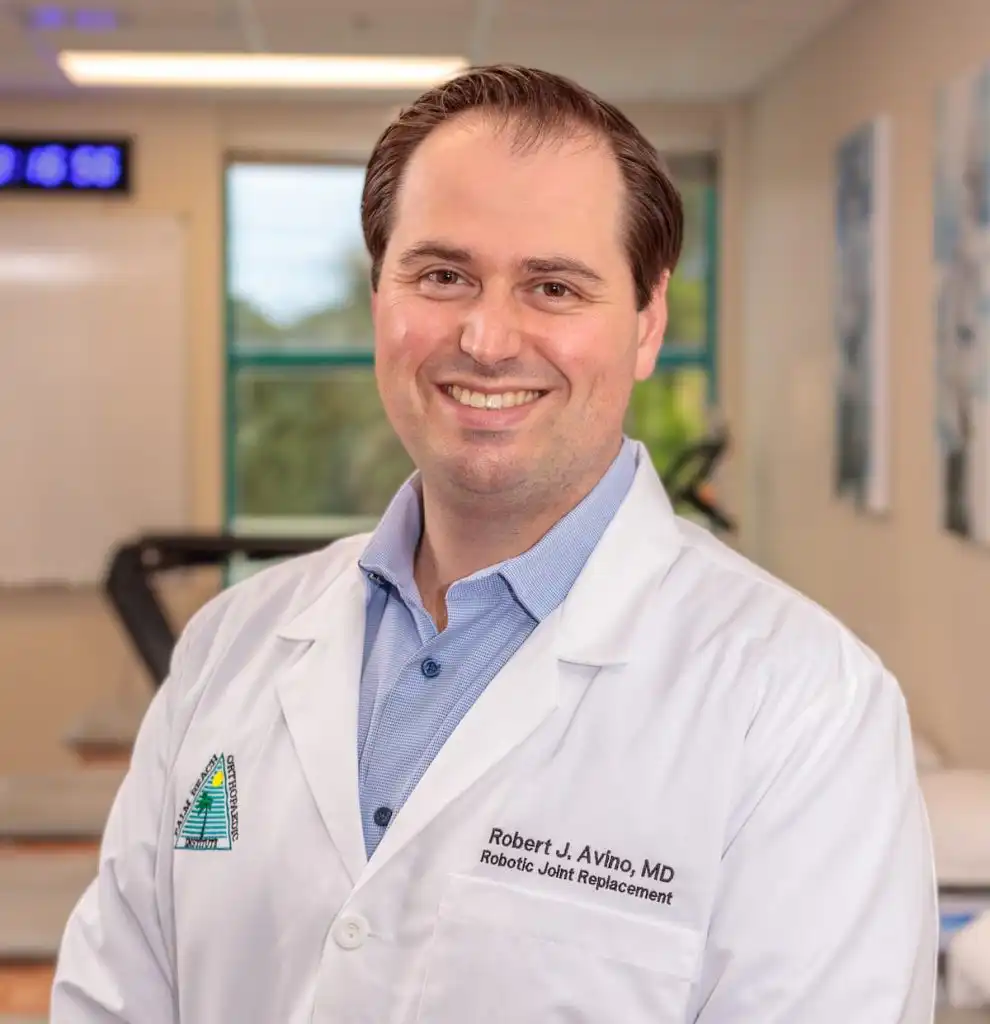
Consider Contacting Us Today
If you are exploring robotic hip or knee replacement in Palm Beach County, Robert J. Avino, M.D., is here to help. Dr. Avino is a board-certified, fellowship-trained orthopedic surgeon who focuses on robotic-assisted hip and knee replacement at Palm Beach Orthopedic Institute in Palm Beach Gardens.
To request a consultation, complete our online contact form, and a team member will follow up. You can also call (561) 694-7776 and ask for Dr. Avino.
Frequently Asked Questions
Many patients do. Golf is generally considered a low-impact activity, and returning to it is a common goal. Whether and when you return depends on your recovery, and Dr. Avino provides individual guidance for each patient.
It varies by patient. Putting and chipping usually come before partial swings, and partial swings before full swings. Your surgeon and physical therapist set the pace based on healing, strength, and balance.
Some golfers notice differences in rotation or balance early on, and many find these improve as strength returns. Physical therapy, and in some cases a lesson with a golf professional, can help you rebuild your swing gradually. Results vary by individual.
Many golfers begin with a cart and return to walking the course as endurance improves. Follow the guidance you receive from your surgeon and physical therapist.